They call it film scoring, but today, it goes well beyond film. There are “movies” everywhere, from full-blown theatrical features to immersive interactive games and experimental web videos. And whether they appear on an IMAX screen or an iPod, whether you hear them in 7.1 surround sound or on a pair of ear buds, they are all accompanied by music that enhances the experience. The craft of creating this music has become one of the world’s most desirable careers.
As a composer for visual media, you’re committed to telling the story that images alone cannot, and we are committed to helping you do that. The Berklee in Valencia master’s degree in scoring for film, television, and video games gives you an advanced education that will sharpen your scoring skills and develop your personal voice. The program focuses on the art and craft of composing, orchestrating, editing, and producing music for the screen. You’ll design an individualized course of study in collaboration with graduate advisors in a manner that best meets your career and artistic goals.
Additionally, Berklee in Valencia, unlike some competing programs, issues master of music degrees—which qualify graduates to teach at many institutions of higher education.
Courses

* Course content is subject to change.
Academic Calendar
The master’s program runs from September to August. For a list of important dates for the upcoming intake, click here.
Outcomes of the Program
Working with a graduate adviser, all master’s students will design a program of study that best supplements and complements their existing knowledge, expertise, and long-term goals. Each student will graduate competent in multi-genre dramatic composition, narrative analysis, studio production, electronic and acoustic arrangement and orchestration, music editing, and interactive scoring.
In three semesters, students complete a minimum of four major scoring projects, including a collaborative video game score (working with video game design students at other institutions) and a master’s thesis project that is portfolio-ready and designed to showcase your style. Core competencies include:
Musical Skills
Students will:
- Compose for a variety of forms and ensembles
- Produce convincing score mock-ups through knowledge of the instruments
- Orchestrate for dramatic effect, even with limited resources
- Identify and utilize an appropriate musical vocabulary for a dramatic media work (film or game)
- Master musical devices pioneered by seminal film composers
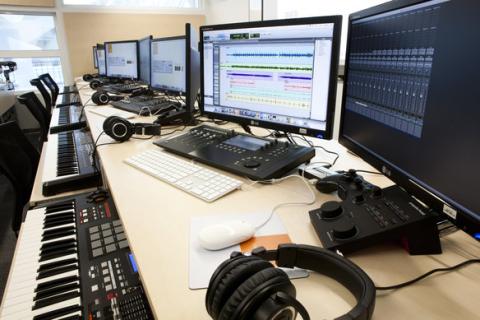
- Become adept in the use of industry-standard music sequencing and audio editing software
- Notate and prepare scores to international studio standards
- Write quickly, write under deadline, and revise without tears
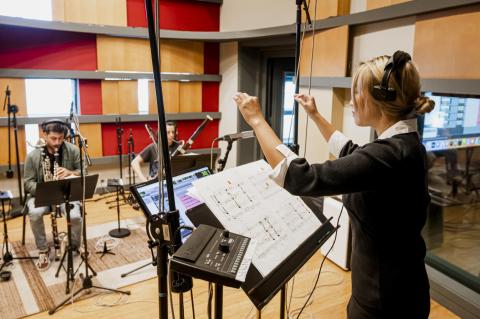
- Conduct and rehearse an ensemble under studio pressure
- Research and write in a specified period or geo-cultural style
- Adapt existing thematic material
- Develop a personal sonic signature
Business and Career
- Market your skills and your personal style
- Collaborate and communicate effectively with clients
- Understand the legal and business aspects of scoring
- Make and maintain a budget
- Know your career options
- Know workflow and scheduling techniques
- Find your own musical voice and cultivate creativity
- Manage your time
- Act as a music supervisor
- Deliver to specifications
Narrative/Drama
- Understand and analyze the role of music in a dramatic medium
- Develop a concept for a score
- Learn to communicate with filmmakers in their language
- Analyze and discuss dramatic structure in a media work
- Analyze the dramatic use of music within a narrative
Technology
- Produce a scoring session
- Compose using various synchronization techniques
- Know and manage modern sample libraries
- Produce an industry-standard orchestral mockup
- Act as a music editor
- Mix your music
- Create and maintain a home studio
- Build instruments through synthesis and/or sampling
Graduates of this unique program will be prepared to begin work immediately in the film, television, or video game music industry in one or more of the following specialties: composing, orchestrating, conducting, music editing, music supervising, copying, programming, and producing mock-ups. The program has been conceived as a portal to the professions and is thoroughly networked with the professional community. The International Career Center will assist your transition to the professional sphere.
Learn more about careers in Scoring for Film, Television, and Video Games.
Who Are We Looking for?
We seek focused, motivated, innovative, and above all, passionately creative candidates with excellent academic and/or professional backgrounds who can contribute skills that will nourish the program.
Because sound compositional practice is the basis for all scoring, ideal candidates will hold degrees in composition or have equivalent professional experience. The ability to notate one’s ideas competently, follow an orchestral score, and conceive material in an orchestral context are required competencies, but extensive experience in working with live orchestras is not.
The use of technology is fundamental to the master’s program; therefore, the strongest candidates will have demonstrable skills in at least one digital audio workstation (DAW) and a working familiarity with ProTools or one of the other most commonly used music sequencing programs, such as Logic, Cubase or Digital Performer. Selected candidates who lack these skills will be required to take summer coursework at Berklee’s Boston campus or other approved facility to prepare them for full and comfortable participation in the master’s program.
Finally, all selected participants will enter the program with a passion for musical storytelling and a demonstrated aptitude for visual music. Because of the high degree of competitiveness in the field, the choice to study visual scoring should not be viewed as a “career option” or a “backup,” but as something you must do. For this reason, first-tier consideration will be given to those applicants whose portfolios evidence experience and skill in creating music to picture and possess an understanding of the basics of the art, craft, and business of film scoring, gained through either study or industry experience. Additional study and/or work experience in the following areas will be helpful but is not required: interactive scoring techniques, conducting to picture, basic music editing skills, and project collaboration.
Eligibility Requirements
Applicants are required to hold a bachelor’s degree or higher in music composition, electronic music production, or performance along with a working familiarity with ProTools or one of the other most commonly used music sequencing programs, such as Logic, Cubase or Digital Performer.
The master’s program as conceived builds upon the strong framework of Berklee’s bachelor of music degree in film scoring; therefore, applicants not possessing this degree should further consult the Berklee College of Music Bulletin to become aware of the competencies desired of individuals seeking entrance into the master’s program.
Admissions Process
There are three steps in the admissions process:
1. Application and fee
2. Interview
3. Final admissions decision
APPLICATION DEADLINES
Early action application deadline: November 30, 2012
Applicants who apply by November 30, 2012 will be notified regarding their acceptance by February 15, 2013.
Applicants to the contemporary performance master’s program who apply by November 30, 2012 and complete their audition by January 31, 2013, will be notified of their acceptance decision by Feb 15, 2013.
Regular action application deadline: March 1, 2013
Applicants who apply by March 1, 2013 will be notified regarding their acceptance by May 15, 2013.
Applicants to the contemporary performance master’s program who apply by March 1, 2013 and complete their audition by April 1, 2013 will be notified of their acceptance decision by May 15, 2013.
Extended application deadline: April 30, 2013
Applicants who apply by April 30, 2013 will be notified regarding their acceptance by May 31, 2013.
Applicants to the contemporary performance master’s program who apply and audition by April 30, 2013 will be notified of their acceptance decision by May 31, 2013.
Applications received after April 30, 2013 will be considered at the discretion of the admissions board.
For complete information about the admissions process, click here.
Tuition and Related Costs 2013-2014 academic year
Application fee (waived for Berklee alumni): $150
Tuition Fee: $35,750
Tuition deposit (non-refundable. This deposit will be credited towards tuition charges): $2,500.00
Comprehensive fee: $1,100*
Late payment fee: $250
Late check-in fee: $250
*The comprehensive fee covers services and facilities that augment the students’ academic experience and includes, but is not limited to, students’ required registration into the Spanish educational system, students’ compulsory health insurance, and a variety of other services and facilities to which students have access.
Laptop and Software Requirements for the Master in Scoring for Film, Television, and Video Games
Berklee College of Music requires all entering master’s students to own a current generation Apple MacBook Pro laptop computer with specific software depending on your program of study. More detailed information will provided on the web after March 30th 2013.
Is the GRE or the GMAT required to apply for this program?
The GRE or the GMAT is not required to apply for this program.
Do I need to have a degree in composition?
Ideal applicants will possess a bachelor’s degree or higher in either scoring or music composition with a specialization in writing for visual media.
How many degree candidates will be accepted into the scoring program?
For the immediate future, we have set an enrollment limit of 20 students per year, all entering in September and completing degree work the following summer.
May someone with a bachelor’s degree from a classical music academy apply?
Yes, of course. Applicants with a B.A., B.F.A., B.M., or B.Mus. in composition or performance from an established conservatory, music academy, or public or private university are strongly encouraged to apply if they have a desire to write music that serves theatrical/visual purposes, or even to master this craft as an adjunct to their concert or performance activities.
How much weight will be given to the required work samples, and how important is it that I include examples of music scored to picture?
Assuming that the rest of your application package (letter of intent, transcripts, letters of recommendation, etc.) is complete and that there are no “disqualifying instances” (such as substandard transcripts or incomplete undergraduate degree requirements), your work samples will carry the greatest weight in the admissions decision. All over the world, graduate schools have become engines of research, new thinking, and new applications. Our “research mission” will be to discover new and more effective ways to utilize music to enhance motion picture art and entertainment. Like all highly selective programs, Berklee in Valencia is interested in attracting men and women with strong potential for success in their field. If you have the drive to create music for motion pictures, it is likely that you also possess the initiative to find a way to do so, even if that means scoring your best friend’s inexpensively made video or using iMovie to assemble a montage of images. This initiative will certainly factor into Berklee’s admission decision.
I am a musician who wants to study film scoring, but my undergraduate degree is not in music. Can I still qualify for acceptance to the master’s program?
Conditionally, yes. Film, television, and game composers come from many different backgrounds. Until quite recently, very few of them had degrees in the field, and many were largely self-taught in music theory. Slowly but surely, this is changing. Berklee’s program is highly selective, and the admissions process will naturally favor applicants with a solid academic grounding in theory, harmony, and composition. However, talent and creativity trump all other considerations, because we are interested in producing graduates with whom filmmakers and game designers will want to work. If your work samples are excellent, your letters of recommendation are compelling, your academic record is strong, and you can demonstrate proficiency in theory and harmony, you can certainly qualify for admission.
What degrees or skills other than music might be attractive to Berklee in Valencia?
Assuming you can demonstrate musical proficiency, an undergraduate degree in film, theater, audio engineering, and/or acoustical studies might make you a good candidate.
I have heard that some top film composers don’t read music. Is this true, and how important are reading and music notation skills in the admissions process?
Most top composers do read music well, although it is certainly not essential for them to be studio-quality sight-readers. Those composers who don’t read probably entered the field based on success in pop, rock, or jazz, where “playing by ear” is the standard. At Berklee, we value ear training as highly as reading, and many of our most accomplished graduates are primarily “ear players.” However, the “gold standard” in writing for films and other visual media is composing for orchestra, and it is impossible to learn orchestral writing if you can’t follow a concert score. At a minimum, we insist that students entering the program are able to find their way through an orchestral score, identify the instruments of the orchestra, and understand basic notational conventions. If you have the talent and drive, but lack the training, there are many forms of individual training and private study available.
How long will the three semesters of the master’s degree program be, and when do they start and finish?
There are two 15-week semesters plus a condensed summer semester for completion of your thesis project and what is described in the course listing as the culminating experience. Basically, the degree program takes one calendar year.
I’m really interested in the M.M. in scoring for film, but I am studying right now for another master’s degree in another city. Is there the possibility to use some of the facilities at Berklee in Valencia?
There are currently no provisions for part-time attendance or auditing of graduate program classes. There will, however, be short courses and workshops scheduled from time to time. Keep an eye on the Berklee in Valencia website.
Who are the faculty for film scoring? Will faculty from the Boston campus teach classes?
As the program is in its first year, we are currently in the process of selecting faculty. Berklee in Boston instructors teaching in Valencia will include celebrated film composer Mason Daring and video game audio designer Ben Houge. A global search is underway for a full-time professor with significant screen scoring credits. Keep an eye on the site for more information as it becomes available.
What facilities do you have to teach scoring for film, television, and video games? Do you have on-site technical support?
The Berklee in Valencia facilities, including all classrooms, labs, and production facilities, are located on the grounds of the magnificent Palau de les Arts Reina Sofia in the City of Arts and Sciences. The Palau itself features an opera house and three state-of-the-art concert halls and offers an unparalleled opportunity for performance of student works. The Berklee in Valencia recording and audio post-production facilities were designed by John Storyk of the Walters-Storyk Design Group, creator of the legendary Electric Lady Studios in New York. All composer workstations are designed to meet or exceed current professional standards, and because admission is selective and class sizes are small, students will have extraordinary access to equipment.
Which guest teachers do you have for scoring for film, television, and video games?
Throughout the academic year, the campus will be visited by notable composers of music for the screen, including such masters as Howard Shore, Alberto Iglesias, Javier Navarrete, Alan Silvestri, and many others. Visiting artists, master classes, and one-on-one mentoring of students are key elements of the program.
How many final compositions will be required for a degree in scoring for film, television, and video games?
You will have writing assignments of various types in many of your classes, each of which is designed to develop certain musico-dramatic and technical “muscles.” Some will involve scoring individual scenes for selected electronic and acoustic ensembles; others will be complete short form projects and games. The most ambitious projects are those that you and your graduate adviser opt to undertake as directed studies. For most students, the final thesis will be a professionally performed and recorded original score for a film, television project, or video game.
What kind of master’s degree is it, master’s of music or master’s of art?
The degree is an M.M., or master’s of music, recognized as such in both Europe and the U.S.
What shall I prepare for my scoring for film, television, and video games interview?
If you have been invited to interview, then your academic achievements, recommendations, and submitted work samples have already been positively received. The interview will be, first and foremost, an opportunity for you to get your questions answered, so bring a list! But it is also a chance for the program director and admissions officers to gauge your dedication and readiness, as well as to recommend any remedial or “bridge coursework” that is desirable.
My specialty is scoring for video games, utilizing dynamic and adaptive game composing techniques. Can there be other musicians, such as a rhythm section, in the video?
The instrumentation in your work, whether it is acoustically or digitally produced, should reflect choices that are appropriate to story and content. If a rhythm section suits the project, then by all means, use it. Same thing goes for a solo piano or a hammer dulcimer. We do strongly recommend that at least one of your work samples be orchestral (midi or live), since this is the gold standard in film music.
What courses will be taught?
There is a complete listing of both required (core) and elective courses on the program website, but you’ll see throughout the list that our focus is on developing three areas of craft: 1) your dramatic instincts and musical storytelling skills; 2) your command of both orchestral and electronic vocabulary for dramatic expression; and 3) your personal voice, or “sonic signature,” which will become your chief asset in this highly competitive field.
What will Berklee in Valencia do to help me find work in the profession?
Berklee offers an International Career Center that maintains constant outreach to all sectors of the music industry. Moreover, the master’s program itself is designed to provide a point of entry to the profession by way of its final semester in Los Angeles and/or other major media music centers, during which graduates will receive intensive mentoring and career assistance.